Tokyo is one of the world's great cities: neon-lit neighbourhoods, extraordinary food, ancient temples beside glass towers, and a precision that makes everything else feel approximate. This guide covers things to do in Tokyo, where to eat, and how to spend 5 days.
Tokyo travel guide essentials: things to do in tokyo, the best tokyo food, tokyo neighbourhoods, tokyo day trips, and where to stay. Tokyo is the world’s largest metropolitan area and one of its most effortlessly navigable, a place where some 37 million people move through an immaculate transit system with a precision that makes other capitals feel improvised.
Nothing in Tokyo works approximately. The trains run to the minute, ramen shops have perfected one bowl over decades, and department store food halls hold more extraordinary things to eat than many whole cities. Everywhere, Shinto shrines sit in the shadows of glass towers: an old city and a futuristic one sharing the same streets.
Tokyo consistently ranks near the top of global lists for safety, food, and transit, and for once the lists are right. It is one of the safest big cities on earth, where lost wallets are routinely handed in to the police. It has more Michelin-starred restaurants than any other city in the world (160 in the 2026 guide). Its neighbourhoods are distinct and walkable, and the care taken over everything from a shop window to a bowl of noodles is unlike anywhere else.
First-timers are often overwhelmed for 24 hours and at ease by day three. Tokyo rewards wandering, and the best moments are often not the famous ones.
Shibuya Crossing is the world’s most famous intersection: when the lights change, as many as 3,000 people surge across from every direction, a choreography nobody appears to coordinate. It is even better at night, when the giant screens light the rain.
Watch from above first. The Shibuya Sky observation deck atop Shibuya Scramble Square gives the best elevated view of the crossing and skyline; tickets cost about ¥2,700 online for daytime slots and ¥3,400 after 3pm (more at the counter), and sunset slots sell out weeks ahead. Then head down and cross it yourself.
From Shibuya, make your way to Omotesando, Tokyo’s most architecturally striking shopping boulevard, where buildings by Tadao Ando, Herzog & de Meuron, and SANAA line a zelkova-shaded avenue leading to Harajuku and Meiji Shrine.
Meiji Shrine, built in 1920 to enshrine Emperor Meiji and Empress Shoken, sits within 70 hectares of forest planted with trees donated from across Japan. A century on, it feels ancient. Enter through the massive torii gate on the Harajuku side and follow the gravel path through the trees; the contrast with the streets behind you is total. Entry is free, and the shrine is open from sunrise to sunset.
Takeshita Street, a few minutes from the shrine entrance, is Harajuku’s famous youth fashion strip: crepe stands, vintage shops, and the street style that has influenced global fashion for decades. Walk it once for the spectacle.
Shinjuku is Tokyo’s other great centre: an enormous business district by day and one of the world’s densest nightlife districts after dark.
Omoide Yokocho (Memory Lane): A narrow alley by Shinjuku Station’s west exit, so tight that smoke from the yakitori grills fills the passage. Tiny counters seat a handful of people each, serving charcoal-grilled skewers and cold beer. Go after 7pm when the stools are full.
Golden Gai: Around 200 tiny bars packed into six narrow lanes, most seating fewer than ten people and each with its own personality, from jazz dens to punk bars. Some welcome only regulars; many welcome strangers. Order a drink and stay for the conversation.
Kabukicho: Tokyo’s loud, neon-saturated entertainment district. Walk through at night for the visual intensity, and look up for the Godzilla head peering over the Hotel Gracery.
Asakusa is Tokyo’s most traditional neighbourhood, anchored by Senso-ji, the city’s oldest temple, whose origins date to 628 AD. The Nakamise shopping street leads from the Kaminarimon (Thunder Gate), whose enormous red lantern is one of Tokyo’s most recognizable images, to the main hall.
Arrive at dawn. The temple grounds are always open, and the early morning atmosphere of incense smoke and locals making offerings is a world away from the midday crowds. The five-storey pagoda photographs beautifully in the morning light.
Across the Sumida River rises Tokyo Skytree, at 634 metres the world’s tallest tower. Observation deck tickets are priced by date, starting from around ¥1,800 when booked in advance. On the riverbank opposite Asakusa, look for the Asahi Beer Hall and its golden flame sculpture.
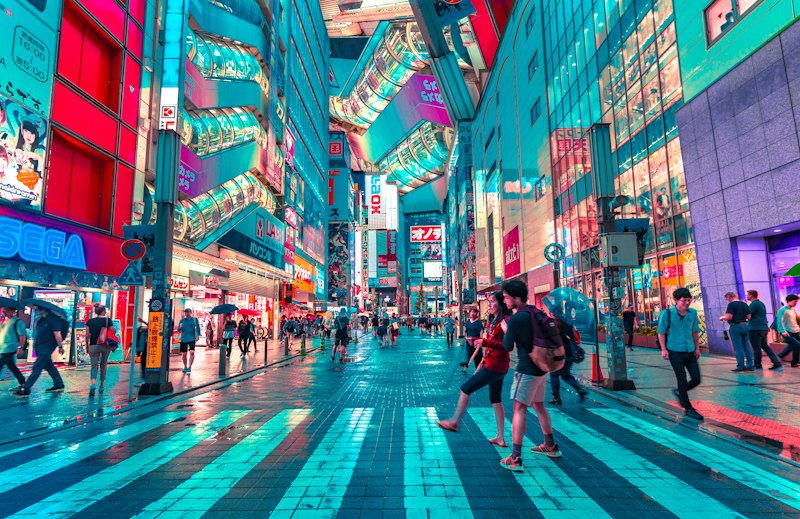
Tokyo’s electronics and gaming district has been a hub of Japanese tech culture since the postwar decades. Multi-storey shops sell everything from vintage Famicom cartridges to high-end audio gear, and the maid cafes are the visible surface of a deep anime and gaming subculture. The retro game shops are a joy for anyone who grew up with video games.
teamLab Planets in Toyosu is Tokyo’s most talked-about contemporary art experience: immersive rooms of infinite reflected light, floating digital flowers, and knee-deep water that you wade through barefoot. Book timed tickets in advance; adult prices vary by date, from roughly ¥3,600 on quiet weekdays to ¥4,200 or more on weekends. teamLab Borderless reopened at Azabudai Hills in 2024 with an updated collection.
Nikko (about 2 hours north by limited express): The Toshogu Shrine complex, founded in 1617 to enshrine Tokugawa Ieyasu, is Japan’s most lavishly decorated historic site, with nearly every surface carved, lacquered, and gilded. Look for the carved sleeping cat (Nemuri Neko) and the three wise monkeys.
Kamakura (about 1 hour south): The Great Buddha at Kotoku-in (¥300) is an 11-metre bronze figure cast in the 13th century, sitting in the open air since its hall was washed away in the late 1400s. Forested hiking trails link the surrounding temples, and Komachi Street is lined with local crafts and matcha sweets.
Hakone (about 1.5 hours): The hot-spring resort area with Mount Fuji views on clear days. The Hakone Open-Air Museum (a sculpture park with a Picasso Pavilion), the ropeway over steaming volcanic vents, and a night in a ryokan with a private onsen are the main draws.
Ramen: Classic Tokyo-style ramen is shoyu (soy sauce) based: a clear, savoury broth with wavy noodles, chashu pork, a marinated soft-boiled egg, and nori. For something different, Ichiran serves Fukuoka-style tonkotsu (rich pork bone) ramen in solo booths, where you customize richness, spice, and noodle firmness on a form and your bowl arrives through a bamboo screen. Several Tokyo branches, including Shibuya and Shinjuku, are open 24 hours.
Sushi: Conveyor-belt chains such as Sushiro and Kura Sushi are cheap and genuinely good, with plates from about ¥120 and English touchscreen ordering. For market-fresh breakfast sushi, head to Tsukiji Outer Market, which still thrives in Tsukiji even though the wholesale fish market moved to Toyosu in 2018. A high-end omakase counter booked through a service such as TableAll is one of the great Tokyo food experiences; expect to pay several hundred dollars per person at top counters.
Tempura: Light batter, sesame oil, precise temperature. Tempura Kondo in Ginza is a benchmark. For an affordable version, try a tempura teishoku (set meal with rice and miso soup) at a casual tempura counter.
Yakitori: Charcoal-grilled chicken skewers, using nearly every part of the bird. Omoide Yokocho in Shinjuku has the atmosphere; the alleys under the train tracks at Yurakucho are the after-work local version.
Depachika (department store food halls): Isetan Shinjuku and Mitsukoshi Ginza have some of the finest food halls on earth: patisseries, wagyu counters, prepared meals, and perfect seasonal fruit wrapped individually. Go before lunch and try every sample on offer.
Convenience stores: Japan’s 7-Eleven, FamilyMart, and Lawson operate at a different level. Onigiri, steamed pork buns, and the famous egg salad sandwich are all genuinely good, and most items cost just a few hundred yen.
Tokyo hotel rates swing sharply by season, so treat these as rough guides and check current prices.
Budget: Nine Hours Shinjuku-North: a sleek, well-designed capsule hotel near Shin-Okubo Station, with pods often under $40 a night.
Nui. Hostel & Bar Lounge, Kuramae (near Asakusa): a riverside hostel with private rooms and dorms and a lively ground-floor bar and café.
Mid-range: Park Hotel Tokyo: occupies the upper floors of a Shiodome tower, with artist-decorated rooms and views over the bay.
Trunk Hotel, Shibuya: a design-forward boutique near Cat Street, ideal for walkability and neighbourhood feel. Rates often run well above typical mid-range prices.
Splurge: The Peninsula Tokyo: facing the Imperial Palace gardens and Hibiya Park, consistently among Asia’s finest hotels. Afternoon tea in the lobby is a Tokyo institution.
Aman Tokyo: on the top floors of Otemachi Tower, with sweeping city views and a spa inspired by traditional Japanese bathing rituals. Expect rates well over $1,000 a night.
Late March to early April (cherry blossom): Tokyo’s sakura typically peaks in late March or early April. Hotels book out months ahead and prices climb sharply. Shinjuku Gyoen, Ueno Park, and the Meguro River are as beautiful as advertised. Stay flexible: peak bloom lasts about a week and shifts with the weather.
October to early December (autumn): Temperatures ease and the city’s parks turn gold and red, with Tokyo’s foliage usually peaking from late November into early December.
May: After the blossoms and before the June rainy season and summer heat. Pleasant, with good availability outside Golden Week.
July and August: Very hot and humid, with temperatures often above 33°C. Still worth visiting, but physically demanding.
Haneda Airport (HND) is about 30 minutes from central Tokyo by Tokyo Monorail or Keikyu Line, making it the easier arrival airport. From Narita (NRT), the Narita Express takes about an hour to Tokyo Station and around 80 minutes to Shinjuku (about ¥3,250 one way to Shinjuku, or ¥5,000 for the N’EX Tokyo round-trip ticket for visitors).
Within Tokyo, the Metro and JR lines cover everything. Pick up a Welcome Suica at the airport (no deposit, valid 28 days), a standard Suica or PASMO (¥500 refundable deposit), or add Suica to your phone, then tap in and out. The JR Yamanote Line loop connects Shinjuku, Shibuya, Harajuku, Akihabara, Ueno, and Tokyo Station, with most rides costing a couple of hundred yen. Google Maps handles Tokyo transit flawlessly.
🎒 Pack for Tokyo: Lightweight Slip-On Shoes Travel · Compact Packable Daypack · Portable Umbrella Compact · RFID Travel Wallet · Portable Power Bank
🗺️ Book Tokyo tours and experiences: Tokyo street food tour and Tsukiji market on GetYourGuide Tokyo day tours and activities on Viator Tokyo experiences on Klook
🛡️ Travel insurance for Japan: Get covered with SafetyWing → 🔒 Stay secure on public Wi-Fi: Get NordVPN →
Tokyo surprises even experienced travellers: the food is better than expected, the transit smoother, the neighbourhoods more distinct. Give it five days at minimum. Walk further than you planned. Eat at the place with no English menu. Stand in the crossing, and let the city do what it does.