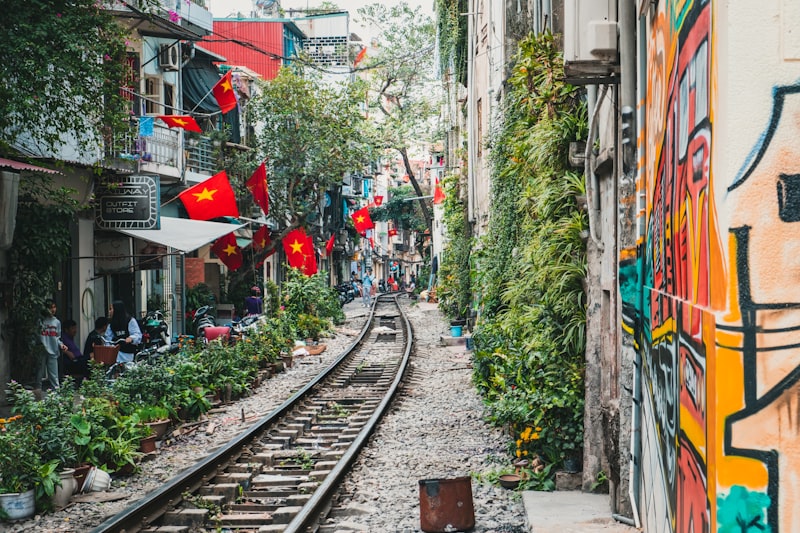
Hanoi is Vietnam's soul: a thousand-year-old capital of French boulevards, ancient temples, and street food eaten on plastic stools at 7am. This guide covers the Old Quarter, what to eat, where to stay, and how to spend 3 days properly.
The first morning in Hanoi, everything happens at once. A woman carries a bamboo shoulder pole stacked with banh mi loaves down a street so narrow her baskets brush both walls. Three men in green army caps play chess on an upturned crate. A moped appears from a direction that should not have had a moped in it, weaves between a fruit cart and a tour group, and is gone. The smell is lemongrass, exhaust, charcoal, rain on old stone, and something deep-frying nearby that stops you mid-stride.
Hanoi is not a city that eases you in, and that is part of why people love it. This hanoi travel guide covers things to do in hanoi vietnam, the best hanoi food, where to stay, and how to spend 3 days in hanoi properly.
Vietnam’s capital has been a seat of power for more than a thousand years (it was founded as Thang Long in 1010) and has the layers to prove it: royal citadel foundations, French colonial villas, Soviet-era concrete, and gleaming glass towers. The Old Quarter is its heart: 36 streets historically named for the guilds that traded there, still chaotic, still alive, and still one of the best places on earth to wander with no particular destination.
Hanoi gets overlooked. Travellers fly in for a night, connect to Ha Long Bay or Hoi An, and never give the city a fair chance. Give it at least two full days; three is better.
The city feels very old and very modern at once. Its street food is among the best in Southeast Asia, the coffee is extraordinary, and its lakes, pagodas, and colonial architecture give it a beauty that Ho Chi Minh City, for all its energy, cannot match. Hanoi is not trying to impress you. It is simply getting on with being itself, which turns out to be very impressive indeed.
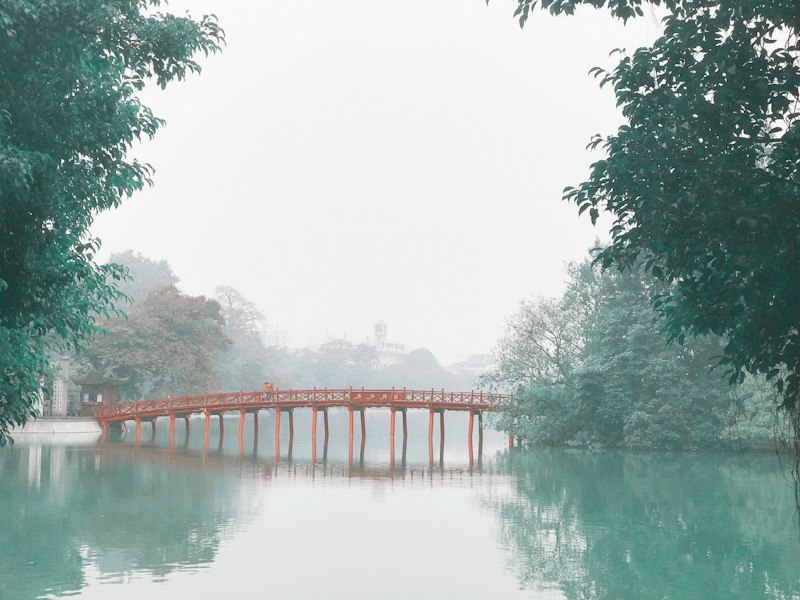
Start here. Hoan Kiem Lake is the geographic and emotional centre of Hanoi: a calm body of water in the middle of the city, linked by the red The Huc Bridge to Ngoc Son Temple on its small island. The name means Lake of the Restored Sword, after a 15th-century legend in which King Le Loi returned a magical sword to a golden turtle. The lake’s last giant softshell turtle died in 2016; its preserved body is displayed at Ngoc Son Temple.
Come at dawn, when Hanoians gather for tai chi, badminton, jogging, and chess. The light is beautiful and the atmosphere entirely local. By 9am the tour groups arrive and the mood shifts.
The Old Quarter begins just north of the lake. Walk up Hang Gai (once hemp rope, now silk), cross into Hang Bac (silver), detour down Hang Ma (paper goods), and keep wandering. Duck into the courtyards behind the shopfronts: many hide small temples, ancestral houses, or workshops still practising old trades.
Founded in 1070 as a temple to Confucius, the Temple of Literature became home to the Imperial Academy, Vietnam’s first university, in 1076. Five courtyards lead from the main gate to the sanctuary, past pavilions, ponds, and 82 stone stelae on turtle backs recording the names of doctoral graduates from examinations held between 1442 and 1779. Standing among them, you are looking at Vietnam’s intellectual history carved in stone.
The temple is busy but large enough to absorb the crowds. Come in the late afternoon, when the light through the old trees turns golden. Open daily 8am to 5pm; entry costs 70,000 VND (about $2.70).
Ho Chi Minh’s embalmed body lies in a glass case at the centre of the mausoleum on Ba Dinh Square, and filing silently past it in a slow-moving queue is a genuinely strange experience. The surrounding complex is worth half a day on its own: the modest stilt house where Ho Chi Minh lived and worked from 1958 until his death in 1969; the Presidential Palace (viewable from outside), which he declined to live in; and the One Pillar Pagoda (Chua Mot Cot), one of Vietnam’s most distinctive buildings.
The mausoleum opens mornings only, is closed on Mondays and Fridays, and closes for roughly two months each year for maintenance (4 September to 2 November in 2026). Dress modestly. Photography inside is strictly prohibited.
One of Southeast Asia’s best ethnographic museums, on Nguyen Van Huyen Street, presents the lives and traditions of Vietnam’s 54 officially recognised ethnic groups. The indoor collection is excellent; the outdoor section, with full-scale traditional houses from the Cham, Jarai, Bahnar, and other groups, is extraordinary. Plan at least two hours. Entry costs 40,000 VND (about $1.50). It is closed on Mondays and sits about 8 kilometres west of the Old Quarter, a cheap Grab ride away.
The French colonial-era prison where American POWs, including future Senator John McCain, were held during the Vietnam War is now a museum. The presentation is one-sided in places, which is itself informative. The original French-era cells, built for Vietnamese political prisoners, are shocking. Entry costs 50,000 VND. Allow an hour.
Bat Trang, about 13 kilometres southeast of central Hanoi on the Red River, has been producing ceramics for more than 700 years. Watch potters at work, buy directly from workshops (far cheaper than Old Quarter shops), and try the wheel yourself. Bus 47A runs from Long Bien bus station in about 40 minutes, or book a half-day tour.
Hanoi’s cooking is its own tradition, distinct from Ho Chi Minh City’s sweeter, richer southern food and from the central dishes of Hoi An.
Pho: The definitive Hanoi breakfast. Northern pho bo is cleaner and less garnished than the southern style: clear broth slow-simmered for hours, flat rice noodles, and rare or well-done beef, with herbs on the side. Pho Gia Truyen at 49 Bat Dan, a Michelin Bib Gourmand pick, opens at 6am and draws queues. Expect 50,000 to 70,000 VND ($2 to $3) a bowl.
Bun cha: Grilled pork patties and pork belly in a sweet-sour fish sauce broth, with rice vermicelli and fresh herbs you combine yourself. Bun Cha Huong Lien on Le Van Huu is where Anthony Bourdain and Barack Obama ate together in 2016, and the “Obama combo” (bun cha, a spring roll, and a Hanoi beer) is still on the menu. Budget $3 to $5.
Banh mi: Banh Mi 25 on Hang Ca Street is the Old Quarter’s most consistent recommendation, with well-balanced pate, pickles, and herbs. About $1.50.
Egg coffee (ca phe trung): Invented in 1946 by Nguyen Van Giang, then a bartender at the Metropole, when milk was scarce: strong Vietnamese coffee topped with egg yolk whipped with condensed milk and sugar. It tastes like tiramisu in a cup. His family still runs Cafe Giang at 39 Nguyen Huu Huan; Cafe Dinh on Dinh Tien Hoang also does an excellent version. Under $2.
Bun bo nam bo: Room-temperature vermicelli with stir-fried beef, fried shallots, peanuts, herbs, and a sweet fish sauce dressing. Lighter than pho and perfect for lunch in the heat.
Budget ($30 to $60/night): La Siesta Classic Ma May, on one of the Old Quarter’s prettiest streets, a short walk from Hoan Kiem Lake. Consistently praised for cleanliness, breakfast, and staff.
Hanoi La Castela Hotel: a small boutique hotel on Hang Manh Street in the Old Quarter, often from under $50.
Mid-range: Hanoi Boutique Hotel & Spa: a 34-room four-star at 83A Ly Thuong Kiet, in the French Quarter a short walk from Hoan Kiem Lake, with a spa, sauna, and good breakfast.
Splurge ($250+/night): Sofitel Legend Metropole Hanoi: the colonial landmark, opened in 1901, which has hosted Charlie Chaplin, Graham Greene, and Jane Fonda. The newer Opera Wing has more modern rooms; the historic Metropole Wing has high ceilings, wooden shutters, and more than a century of atmosphere. Usually from about $250.
Capella Hanoi: an opulent, opera-themed luxury hotel near the Opera House with spectacular interiors. Rates generally start around $400.
October to December is the most pleasant time: the summer heat has broken and temperatures sit roughly between 18 and 28°C. October is excellent.
March and April are warm and often sunny, a good window before the summer heat.
May to September is hot and humid with regular rain; June to August can reach 35°C. Tiring for walking, but manageable.
January and February can feel cold by Vietnamese standards, dropping to around 12 to 13°C at night. Bring a layer. Tet (Lunar New Year) falls in late January or February; many businesses close for several days, which makes for an atmospheric but logistically tricky visit.
Noi Bai International Airport is about 28 kilometres from the Old Quarter. A Grab or taxi takes 40 to 60 minutes and costs roughly 250,000 to 400,000 VND ($10 to $15); use the official taxi rank or a ride-hailing app (Grab, Be, or Xanh SM). Airport express bus 86 runs to Hoan Kiem Lake and the railway station for 45,000 VND, taking about an hour.
Within Hanoi, Grab is the easiest option for point-to-point travel, and walking works well within the Old Quarter. Bicycles can be rented cheaply if you are comfortable in chaotic traffic; nervous cyclists should skip it.
🎒 Pack for Hanoi: Lightweight Rain Jacket · Comfortable Walking Shoes · Travel Money Belt · Insect Repellent DEET · Power Bank Portable Charger
🗺️ Book Hanoi tours and experiences: Hanoi Old Quarter street food walking tour on GetYourGuide Ha Long Bay cruise from Hanoi on GetYourGuide Hanoi day tours and activities on Viator Hanoi experiences on Klook
🛡️ Travel insurance for Vietnam: Get covered with SafetyWing → 🔒 Stay secure on public Wi-Fi: Get NordVPN →
Hanoi takes about a day to stop being overwhelming and start being wonderful. Give it that day. Walk further than you planned. Eat at the place with plastic stools and no English menu. Drink egg coffee in a café with a ceiling low enough to touch. Sit by Hoan Kiem Lake at dusk and watch the city drift past. Some cities are best experienced; Hanoi is best absorbed.