A week exploring Cambodia's temples: from Angkor Wat at sunrise to jungle-swallowed ruins at Ta Prohm. What to see, where to stay, and how to avoid the crowds.
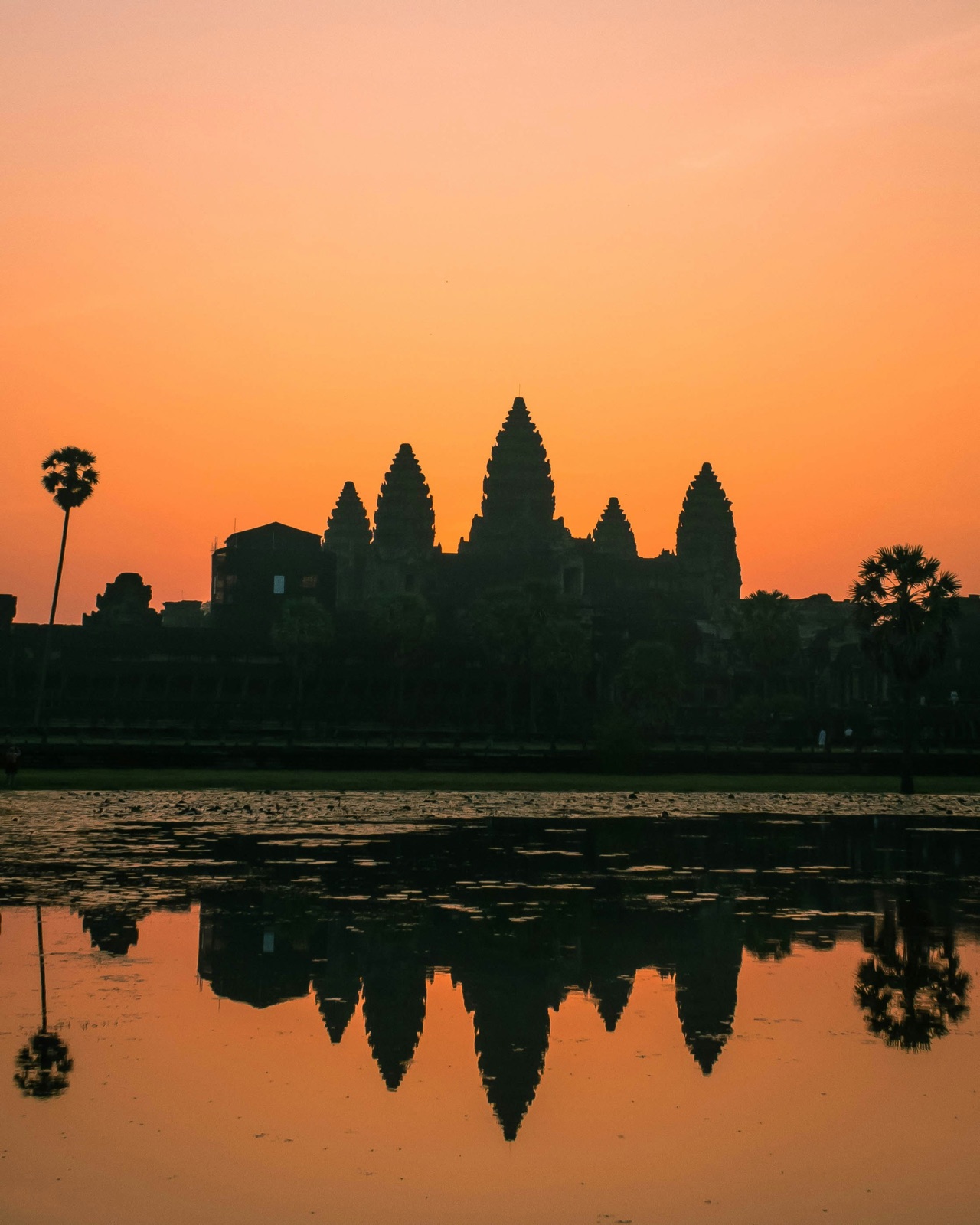
The sky is still ink-black when your tuk-tuk rattles down the road toward Angkor Wat, the headlamp cutting a pale ribbon through humid air. Then the horizon begins to blush. Coral bleeds into gold, and the five lotus towers of Angkor Wat rise from the darkness like something conjured rather than built, mirrored in the still water below. You are standing before the largest religious monument on earth, and it has just stolen your breath. This is Cambodia: ancient, humbling, and utterly alive.
Most visitors base themselves in Siem Reap, the gateway town to Angkor. Angkor Wat tickets (called an Angkor Pass) are sold at the official ticket centre and online through Angkor Enterprise, and cost $37 for one day, $62 for three days, and $72 for seven days. Cambodia punches far above its weight, and its magic is in the contrasts: you move from one of humanity’s greatest architectural achievements to a night market selling grilled skewers for pocket change, from jungle-swallowed ruins to a riverside capital still reckoning with a painful history. The Khmer Empire that built Angkor dominated much of mainland Southeast Asia from the 9th to the 15th century, and the artistry and ambition in these stones are staggering.
Angkor Wat at Sunrise, and Why You Need a 3-Day Pass
The single most important piece of advice for any Cambodia trip: buy the three-day pass ($62, usable on any three days within ten), not the one-day. The Angkor Archaeological Park covers roughly 400 square kilometres and dozens of major temples; a single day produces only temple fatigue. Angkor Wat opens at 5am for sunrise, so arrange your tuk-tuk driver the night before and leave your guesthouse by about 4:45am. Stake out a spot by the reflecting pool to the left of the main causeway. The light changes fast, and tour groups pour in soon after sunrise, so head inside once the sky brightens and climb to the upper level before queues form.
Bayon: Some 200 Stone Faces Watching You
At the heart of Angkor Thom, Bayon is Angkor Wat’s stranger, more intimate sibling. Its towers bristle with enormous carved faces, serene and slightly smiling, gazing in every direction. They are thought to depict the bodhisattva Avalokiteshvara, though many scholars believe they also portray the Khmer king Jayavarman VII, who built the temple. Walk slowly: the faces appear gradually, like figures stepping out of fog. Come early in the morning or late in the afternoon, when the light turns amber and the midday crowds have gone.
Ta Prohm: Where the Jungle Fought Back
This is the temple time tried to reclaim. Massive silk-cotton and strangler fig trees have sent their roots through walls and doorways, splitting lintels and swallowing entire galleries. Ta Prohm was deliberately left largely unrestored, and its atmospheric ruins famously appeared in the 2001 film Lara Croft: Tomb Raider. Come when the gates open at 7:30am or after 4pm; at midday the crowds make the magic evaporate.
Preah Khan for Crowd-Free Exploration
On your second or third day, make time for Preah Khan, a vast temple complex just north of Angkor Thom that most visitors skip. You may have entire corridors to yourself. Partly unrestored, with roots prying apart doorways, it feels genuinely mysterious. Many tuk-tuk drivers know these sites well, but for real historical depth, hire a licensed guide.
Siem Reap Town and Phnom Penh
Siem Reap’s Pub Street and Night Market are exactly what they sound like: lively and tourist-friendly. Wander toward the Old Market area for proper Cambodian food. Order fish amok (a fragrant coconut curry steamed in banana leaf) or lok lak (stir-fried beef with a peppery lime dipping sauce) at a plastic-table spot full of locals. If your itinerary allows a few extra days, Phnom Penh rewards the effort: the Silver Pagoda in the Royal Palace grounds is a masterpiece of Khmer craftsmanship, and the Tuol Sleng Genocide Museum is difficult, essential history that explains modern Cambodia in ways the temples cannot.
Budget: Onederz Siem Reap is a five-minute walk from Pub Street and the Night Market, with clean dorms and private rooms at backpacker prices and swimming pools that feel like a real luxury.
Mid-range to upscale: Shinta Mani Angkor, designed by Bill Bensley, offers beautifully styled rooms and pools in a quiet corner of town. The staff know temple logistics inside out and can arrange sunrise drivers and guides.
Luxury: Amansara is the benchmark. Once a guesthouse for visitors of King Norodom Sihanouk, this 1960s New Khmer landmark has just 24 suites, many with private plunge pools, plus private temple tours and vintage car excursions. Rates sit firmly in once-in-a-lifetime territory.
November through February is Cambodia’s sweet spot: dry, with temperatures around 25 to 32°C (77 to 90°F) and gorgeous light for temple photography. March and April are intensely hot. The wet season (May to October) brings afternoon downpours, but also lush green landscapes, far fewer tourists, and lower prices. October, at the tail of the rains, is a good compromise.
Siem Reap Angkor International Airport (SAI), which replaced the old downtown airport in October 2023, receives direct flights from Bangkok, Kuala Lumpur, Singapore, Ho Chi Minh City, and other regional hubs. It sits about 50 kilometres east of town, so allow roughly an hour for the transfer. Phnom Penh (PNH) is also well connected. Around Siem Reap, tuk-tuks are the classic temple transport: budget about $15 to $25 a day for a driver who waits at each site. Cycling is a lovely alternative on the flat roads between the main temples, and bicycles are cheap to rent in town.
🎒 Pack for Cambodia: Lightweight Linen Clothing · Insect Repellent · Compact Travel Umbrella · Travel Packing Cubes · Electrolyte Tablets
🗺️ Book tours & experiences in Cambodia: Browse on GetYourGuide → · Browse on Viator → 🌅 Angkor Wat sunrise tour with a guide: Book on Klook → 🏙️ Phnom Penh city highlights tour: Book on Klook →
🛡️ Travel insurance for this trip: Get covered with SafetyWing → 🔒 Stay secure while travelling: Get NordVPN →
Cambodia stays with you long after you leave: in those stone faces gazing calmly into the jungle, in fish amok eaten at a wobbly plastic table while a monsoon hammers the tin roof, in the warmth of a tuk-tuk driver who becomes, after three days, something close to a friend. Book the flight. Pack light. Cambodia will take care of the rest.