The Maldives doesn't have to cost $800 a night. Local island guesthouses, smart transfers, and a few insider tricks put it within reach of normal travel budgets.
The speedboat cuts across water so blue it looks digitally enhanced, and then the island appears: a smear of white sand and swaying palms rising from an impossible lagoon. You didn’t spend a fortune to get here. You’re arriving at Maafushi, one of the Maldives’ local guesthouse islands, where a clean double room can cost around $80 to $100 a night instead of $800. The Maldives has long been sold as a playground for honeymooners and billionaires, but the turquoise water and coral gardens are within reach if you know which islands to book, which boats to catch, and when to go. A cheap Maldives holiday is built around budget Maldives guesthouses on local islands like Maafushi, Dhigurah, and Fulidhoo, where a Maldives local island stay costs a fraction of a resort overwater bungalow.
Nowhere else looks quite like this. The Maldives is an archipelago of roughly 1,200 coral islands scattered across the Indian Ocean, so low that the highest natural point is only a few metres above sea level. Water wraps everything: luminous, warm, and alive with reef sharks, manta rays, turtles, and dazzling coral. Snorkelling off a sandbank at dawn, with a reef shark drifting beneath you in clear shallow water, is an experience few places can match.
Snorkel from Maafushi and Thulusdhoo These two local islands are budget travellers’ favourite bases. Maafushi, about 30 to 45 minutes by speedboat from Malé, has dozens of guesthouses and a designated “bikini beach” where Western swimwear is permitted. Its own reef is modest, but cheap half-day boat trips run to nearby reefs and sandbanks, with good odds of turtles, reef sharks, and colourful coral. Thulusdhoo, in North Malé Atoll, is famous among surfers for Cokes, a powerful right-hand reef break; non-surfers come for the quiet. Guesthouses on both islands rent or lend snorkel gear for a few dollars.
Chase whale sharks in South Ari Atoll South Ari Atoll is one of the few places on earth where you can find whale sharks year-round. Most are juveniles, often 5 to 8 metres long, feeding and cruising along the outer reef. The easiest way to see them is to base yourself on Dhigurah, a local island right beside the whale shark area, where guesthouses run excursions; long day trips from the Malé area are also possible but cost more. Swimming beside the world’s largest fish is unforgettable. Follow your guide’s rules: keep your distance and never touch.
Go liveaboard diving For serious divers, a liveaboard is arguably the best value in the Maldives. A week aboard a dive boat, sailing between atolls and reaching sites day-trippers can’t (such as the hammerhead dives off Rasdhoo Atoll and the manta cleaning stations of Ari and Baa atolls), typically includes your cabin, all meals, and three or so dives a day. Compare boats on platforms such as PADI Travel or Liveaboard.com, and book several months ahead for the best rates.
Take the Malé layover seriously Don’t just rush through Malé. The capital is one of the most densely populated cities on the planet: a maze of pastel buildings, markets, and mosques crowded onto a tiny island. Visit the waterfront fish market to watch the day’s catch come in, eat a breakfast of mas huni (tuna, coconut, and onion) with roshi flatbread at a local café for a few dollars, and see the coral-stone Old Friday Mosque (Hukuru Miskiy).
Budget, Kaani Beach Hotel, Maafushi: Clean, comfortable rooms steps from the bikini beach, with a rooftop restaurant and staff who arrange snorkelling trips and transfers. Doubles typically start around $80 to $100 a night with breakfast.
Mid-range, Kuredu Island Resort, Lhaviyani Atoll: A big, lively resort island reached by seaplane or domestic flight and speedboat, with beach bungalows, pool villas, a house reef with resident turtles, and all-inclusive packages that make budgeting easy.
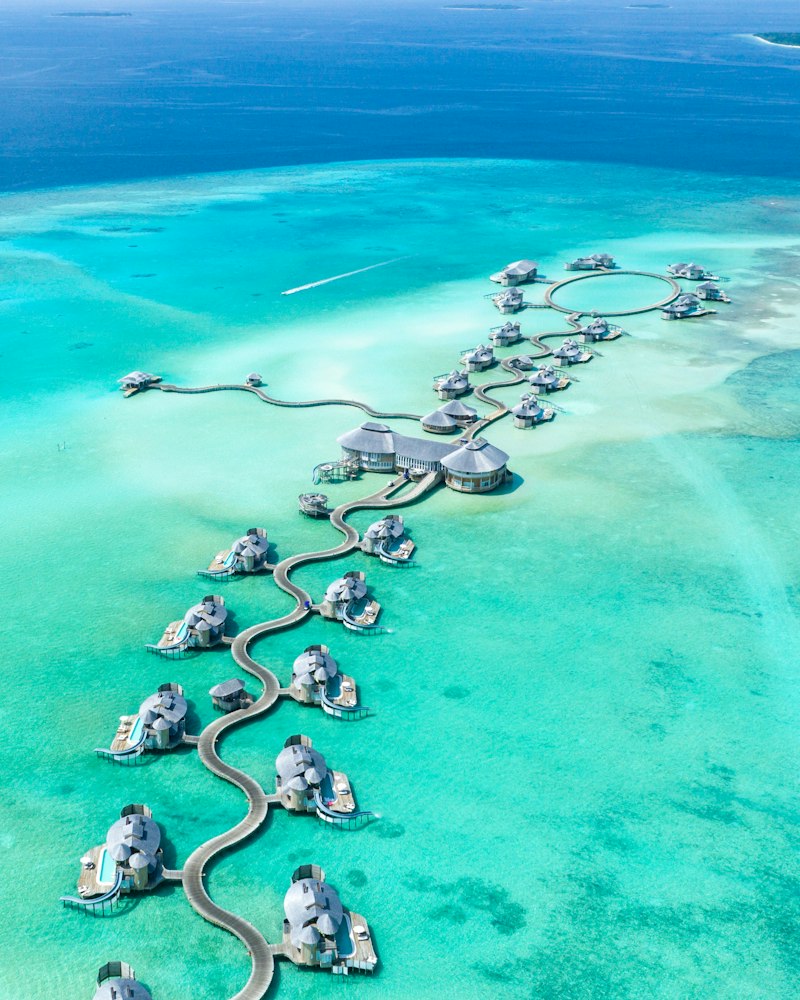
Luxury, Soneva Jani, Noonu Atoll: If you’re going to splurge, do it here. Overwater villas come with retractable roofs for stargazing, and some have slides straight into the lagoon. Rates run to several thousand dollars a night, so save it for a very special occasion.
The Maldives is at its best between December and April, the dry northeast monsoon season, with sunny weather, calm seas, and excellent underwater visibility. November and early May are good-value shoulder periods. May through October brings the southwest monsoon, with more rain and choppier water, but prices drop noticeably and the islands are quieter. Hanifaru Bay’s manta aggregations peak during this wetter season, roughly June to November.
Fly into Velana International Airport (MLE) near Malé, which has direct flights from Dubai, Doha, Abu Dhabi, Istanbul, Singapore, Colombo, and other hubs, with easy connections from Europe and North America. From the airport, seaplanes reach distant resort atolls quickly (return transfers often cost $500 to $1,000 or more per person), while public ferries (just a few dollars, but infrequent) and shared speedboats serve the local islands. For Maafushi or Thulusdhoo, a shared speedboat from the airport jetty typically costs about $25 to $40 per person each way and takes under an hour.
🎒 Pack for the Maldives: Snorkel Mask · Reef-Safe Sunscreen · Underwater Camera · Waterproof Dry Bag · Quick-Dry Beach Towel
🗺️ Book tours & experiences in the Maldives: Browse on GetYourGuide → · Browse on Viator →
🛡️ Travel insurance for this trip: Get covered with SafetyWing → 🔒 Stay secure while travelling: Get NordVPN →
The Maldives doesn’t have to stay a fantasy. With a guesthouse on Maafushi, a whale shark swim in South Ari, and a sunrise snorkel over a quiet reef, you can have the experience every luxury magazine sells at a fraction of the price. The water is the same turquoise. The reef sharks don’t care about your budget. Book the flight.