The Australia working holiday visa is one of the most generous in the world. Here's exactly how to use it to travel and earn for up to three years.
The alarm goes off at 4:30am, but you don’t mind. Outside the bunkhouse window, the Bundaberg sky is fading from black to bruised purple, and the air smells of damp earth and something sweet: strawberries, thousands of them, running in long green rows toward the horizon. By lunchtime you’ll have earned enough for a few nights of camping further up the coast. This is the Australia Working Holiday in its purest form: outdoor work by morning, a sunset drink by evening, and a continent ahead of you. It’s exhausting, unglamorous, and wildly freeing, and for travellers aged 18 to 30 (or 35 for some nationalities), it might be the best year of your life.
Australia is enormous, roughly the size of the mainland United States, and a working holiday visa is your ticket to actually explore it. It lets you work legally for 12 months, with the option to extend to a second and third year by completing specified work in regional Australia. The Australia working holiday visa comes in two streams: the Working Holiday visa (subclass 417) for 19 countries and territories including the UK, Ireland, Canada, France, Germany, and Japan, and the Work and Holiday visa (subclass 462) for around 30 more, including the United States. The usual age limit is 18 to 30, extended to 35 for citizens of Canada, France, Ireland, the UK, and a few others. Add red desert, coral reef, wine country, endless surf beaches, and strong wages, and few places reward slow, self-directed travel so well.
Drive the East Coast: Sydney to Cairns. The classic working holiday road trip runs roughly 2,500 to 3,000 kilometres up the coast of New South Wales and Queensland. Hire a campervan in Sydney, spend a week of surf lessons and live music in Byron Bay, sail the Whitsundays (74 islands) on an overnight backpacker boat, then finish in Cairns for Great Barrier Reef snorkelling. Budget at least a month; two or three is better.
Snorkel the Ningaloo Reef, Western Australia. The East Coast gets the attention, but Ningaloo, near Exmouth, is arguably the better reef experience, and at spots like Turquoise Bay you can snorkel straight off the beach. From roughly March to July, whale sharks cruise these waters; a guided swim tour costs several hundred dollars.
Spend a week in the Red Centre. Fly or drive to Uluru (about 450 kilometres from Alice Springs) and buy a pass for Uluru-Kata Tjuta National Park (AUD 38 for three days). Watch the rock shift from ochre to deep crimson from the sunset viewing area, stay at the campground to save money, and walk the 10.6-kilometre base walk at dawn before the heat builds.
Camp the Kimberley, Western Australia. The Gibb River Road between Derby and Kununurra is about 660 kilometres of corrugated dirt track through gorges, waterholes, and absolute solitude. It is open only in the dry season and requires a high-clearance 4WD and careful fuel planning, but the payoff (swimming at Bell Gorge and Manning Gorge) is unlike anywhere else on earth.
Hit Melbourne’s coffee and culture scene. Most working holidaymakers stay in Melbourne longer than planned. Start your morning at Market Lane Coffee, spend an afternoon at the National Gallery of Victoria (general entry is free), and catch cheap live music in Fitzroy on almost any night.
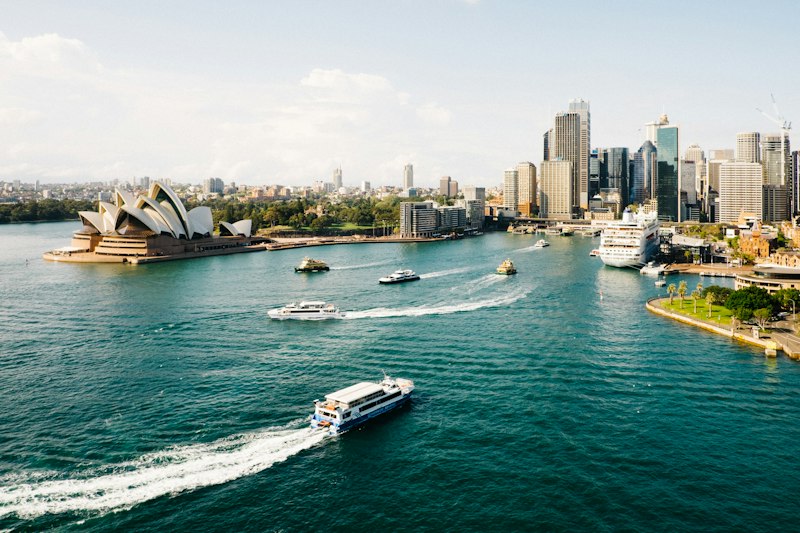
Budget: YHA hostels are the backbone of Australian backpacking. Sydney Harbour YHA in The Rocks has rooftop views of the Opera House and Harbour Bridge, and dorm beds are among the cheapest ways to sleep in central Sydney. YHA membership is free and unlocks member rates.
Mid-range: Ovolo Woolloomooloo in Sydney, set in a converted wharf, and Ovolo South Yarra in Melbourne offer boutique style and a social atmosphere that feels above their price point.
Luxury: For a once-in-a-trip splurge, Longitude 131° near Uluru is a luxury tented camp with views of the rock from your bed. All-inclusive rates run to several thousand dollars per night.
Australia’s size means there is no single perfect time. The tropical north (Darwin, Cairns, the Kimberley) is best in the dry season, May to October; the wet season (November to April) brings heat, humidity, and cyclones. The south (Sydney, Melbourne) is most pleasant from October to April. Summer bushfire smoke can affect parts of the southeast, so check conditions if you have respiratory sensitivities. April to May and September to October offer good weather across much of the country.
Sydney (SYD) and Melbourne (MEL) are the main international gateways, with one-stop flights from London (about 22 to 24 hours) and nonstop flights from Los Angeles (around 15 hours) and Singapore (about 8 hours). Fares vary widely by season, so book early for December and January. Once you arrive, the most flexible option is buying a used campervan or car in Sydney or Melbourne (Facebook Marketplace and backpacker boards are full of them; always get a mechanical inspection). Greyhound Australia sells flexible hop-on hop-off passes for budget travellers on the East Coast.
🎒 Pack for Australia: Travel Backpack 40L · Portable Power Bank · Australia Travel Adapter · Reef-Safe Sunscreen · Quick-Dry Travel Clothing
🗺️ Book tours & experiences in Australia: Browse on GetYourGuide → · Browse on Viator → 🐠 Great Barrier Reef snorkelling and diving tour: Book on Klook → 🎭 Sydney Opera House guided tour: Book on Klook → 🏔️ Blue Mountains day tour from Sydney: Book on Klook →
🛡️ Travel insurance for this trip: Get covered with SafetyWing → 🔒 Stay secure while travelling: Get NordVPN →
You arrive with a one-year visa and a rough plan, and you may leave years later with a van full of stories, a collection of national park stickers, and proof that you funded the whole adventure yourself. Book the flight. Sort the paperwork. The strawberry rows, the coral reefs, and that first Uluru sunset are waiting.