The world's best scuba diving sites, from Raja Ampat and Palau to the Great Barrier Reef, the Maldives, and Cozumel, ranked by what you'll actually see underwater.
You drop beneath the surface and the noise of the world vanishes. A hawksbill turtle glides past within arm’s reach, utterly unbothered. Below you, a coral wall tumbles into deep blue. Reef sharks patrol the edge of visibility, and a school of barracuda wheels overhead like a silver chandelier. Whether you’re a certified diver with a full logbook or someone who has dreamed of trying it for years, 2026 is the year to finally go deep. The world’s great dive sites are waiting.
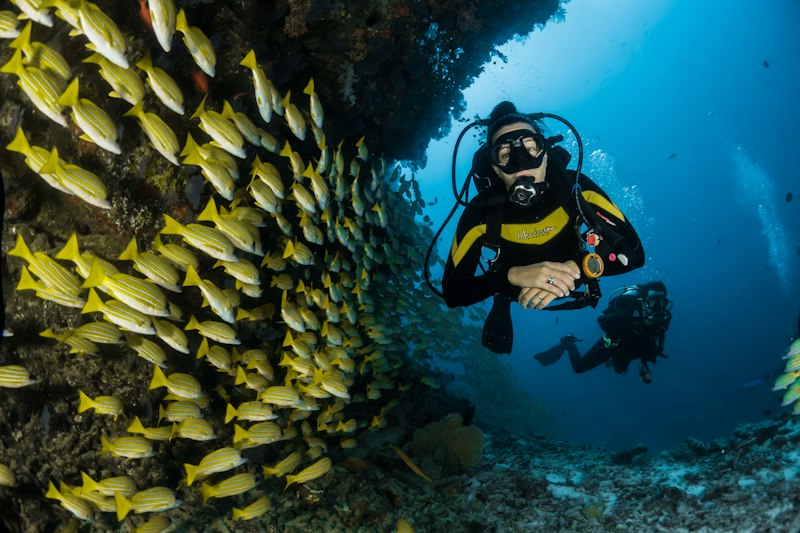
Scuba diving is access to a planet most people never see. About 71 percent of Earth’s surface is ocean, and almost none of its life is visible from above. Dive in and you’re surrounded by ancient coral gardens, WWII wrecks draped in soft coral, and caves submerged since the last ice age. The learning curve is gentle: a PADI or SSI Open Water certification takes three to four days and costs around $300 to $400 in budget hubs like Koh Tao, Thailand. The best scuba diving destinations in 2026 include the Coral Triangle (Philippines, Indonesia, Malaysia), the Maldives, the Red Sea, and Australia’s Great Barrier Reef diving, still the largest coral reef system on earth despite repeated bleaching. Once certified, the whole underwater world opens up, from tropical reefs to kelp forests off California.
Raja Ampat, Indonesia: The World’s Richest Reef
No dive destination matches Raja Ampat for marine biodiversity. At the heart of the Coral Triangle off West Papua, these islands host more than 1,500 fish species and about 75 percent of the world’s known coral species. The Misool region in the south is legendary for soft corals, saffron-coloured sea fans, pygmy seahorses on gorgonians, and wobbegong sharks resting on the bottom. Manta Ridge near Arborek Island sees regular manta aggregations, especially from roughly October to April. Liveaboards offer the widest access, while homestays and dive resorts offer cheaper land-based diving. All visitors must buy a Raja Ampat marine park entry permit. Fly into Sorong via Jakarta or Makassar.
Great Barrier Reef, Australia: Iconic and Still Breathtaking
Despite recent mass bleaching events, many sections of the Great Barrier Reef remain spectacular, particularly on the outer reef. Cod Hole on Ribbon Reef No. 10 is famous for giant potato cod that nose up to divers like curious dogs. Osprey Reef, far out in the Coral Sea, delivers sheer walls dropping into oceanic depths and regular shark encounters; it’s reached only by multi-night liveaboards from Cairns or Port Douglas. Liveaboards of three nights or more reach the Ribbon Reefs, while day trips from Cairns and Port Douglas visit outer reef sites suitable for beginners. Many operators offer nitrox for longer bottom times.
Palau, Micronesia: Wrecks, Walls, and Jellyfish Lake
Palau is serious diving. Dozens of Japanese ships sunk by US carrier aircraft during Operation Desecrate One in March 1944 lie in the lagoon around Koror, among the most atmospheric wreck dives in the Pacific. The Iro Maru, a fleet oiler resting at around 40 metres, is now encrusted with coral. Blue Corner is Palau’s signature reef dive: a current-swept drop-off where you clip onto the reef with a reef hook and watch grey reef sharks, eagle rays, and schooling fish cruise past. Jellyfish Lake, a marine lake filled with stingless golden jellyfish, is a snorkel-only experience; numbers fluctuate, so check its status locally. Most diving is by day boat from Koror, and flights reach Palau (ROR) via Guam, Manila, Taipei, and other Asian hubs.
Maldives: Drift Diving with Whale Sharks and Mantas
The Maldives is a drift diver’s paradise. Currents funnel through channels in the atolls, concentrating plankton and drawing in pelagic life on a staggering scale. Hanifaru Bay, in the Baa Atoll UNESCO Biosphere Reserve, hosts some of the world’s largest manta feeding aggregations, mainly from about June to November; it’s strictly protected and open to snorkellers only, with scuba diving banned inside the bay. Whale sharks can be seen year-round in the South Ari Atoll Marine Protected Area. Master your buoyancy before you go, as currents can be powerful. Liveaboards offer the best access to remote sites across multiple atolls.
Cozumel, Mexico: Visibility and World-Class Drift Diving
For North American divers, Cozumel is a dream destination. Visibility regularly exceeds 30 metres in the clear Caribbean water of the Mesoamerican Reef, and the gentle drift along Palancar Reef, with its coral towers and swim-throughs, feels effortless. The deeper Santa Rosa Wall attracts eagle rays, turtles, and nurse sharks. Cozumel is about 45 minutes by ferry from Playa del Carmen, making it easy to pair with the Yucatán, and non-diving partners are well catered for. Dive operators rent all the gear, so you can fly in with just your certification card.
Budget: On Koh Tao, Thailand, Sairee Cottage Resort offers simple bungalows near the beach with an on-site dive centre, the classic budget move for getting certified.
Mid-range: In Cozumel, Casa Mexicana sits on the waterfront in San Miguel town, with a pool and easy access to dive operators along the seafront.
Luxury: In the Maldives, Six Senses Laamu has overwater villas, an in-house marine conservation team, and a dive centre exploring Laamu Atoll’s reefs. Rates typically start above $1,000 per night, a true special-occasion splurge.
Dive seasons vary sharply. Raja Ampat is best from about October to April, when seas are calmer and mantas more frequent. Great Barrier Reef diving is good year-round, with drier, calmer weather from about June to November. Palau is diveable year-round, with the calmest conditions in the drier months from about November to April. Maldives manta season at Hanifaru runs roughly June to November, and the northeast monsoon (December to April) brings the calmest seas and best visibility on the east side of the atolls. Cozumel is diveable year-round, with the warmest water from about June to September and hurricane risk from roughly August to October.
Each destination has its own gateway: fly into Sorong for Raja Ampat, Cairns for the outer Great Barrier Reef, Koror (ROR) for Palau, Malé (MLE) for the Maldives, and Cozumel (CZM) or Cancún for Mexico. Dive operators handle most logistics, with boats, tanks, and weights provided. In Raja Ampat and the Maldives, liveaboards remove the hassle of inter-island transport. Cozumel is small enough to explore by scooter or rental car.
🎒 Gear up for diving: Dive Mask · Dive Fins · Underwater Camera · Reef-Safe Sunscreen · Dry Bag
🗺️ Book dive tours & experiences worldwide: Browse on GetYourGuide → · Browse on Viator →
The ocean doesn’t care about your inbox or your deadlines. The moment you descend, all of that disappears, leaving presence, colour, silence, and a living world most people never discover. Pick a destination, book your flights, and dust off your logbook or sign up for your first Open Water course. The best dive of your life is out there.
🛡️ Travel insurance for this trip: Get covered with SafetyWing → 🔒 Stay secure while travelling: Get NordVPN →