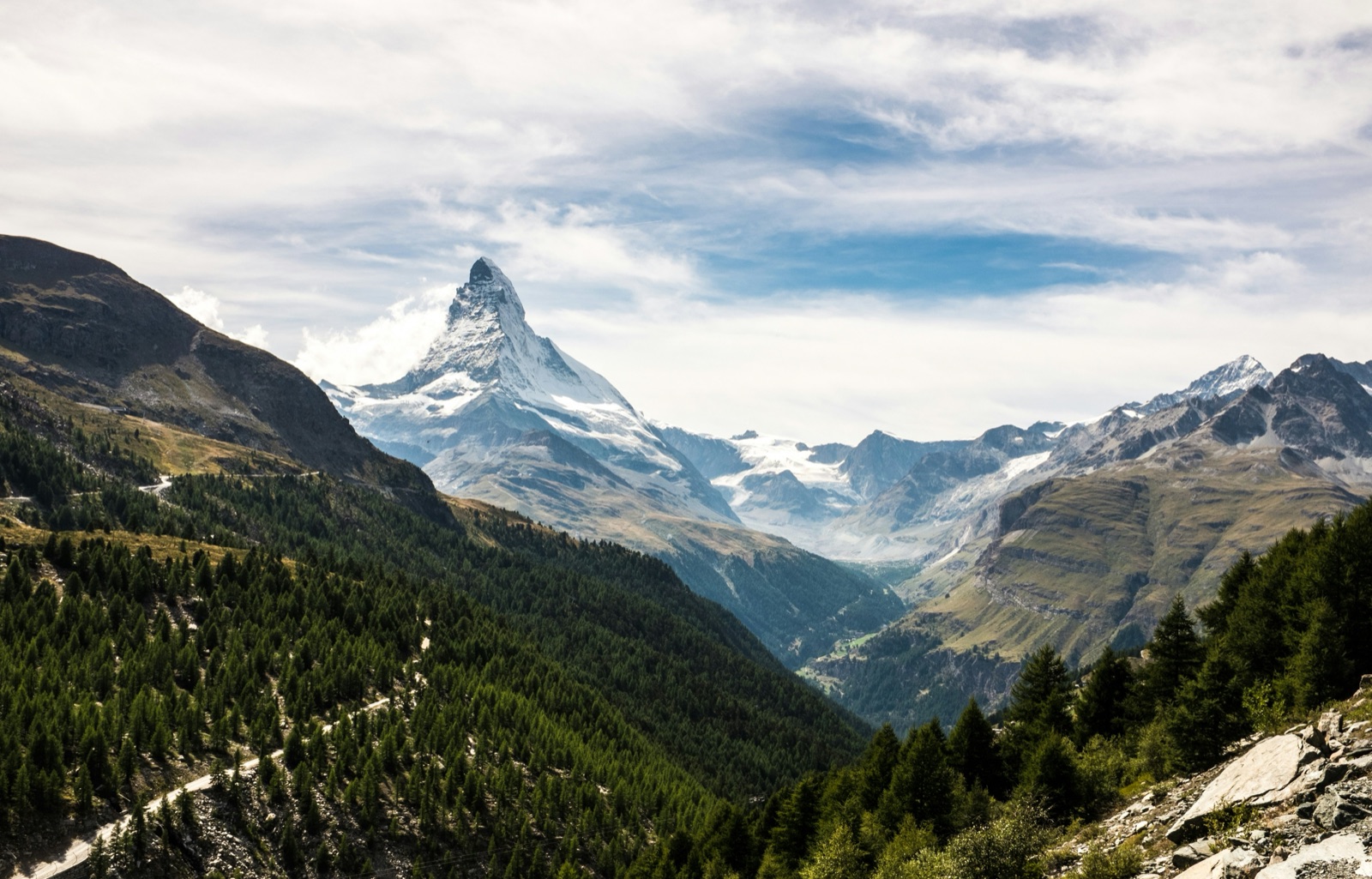
The Swiss Alps deliver some of Europe's most dramatic scenery: snow-capped peaks, glacial lakes, and car-free villages. Here's where to go, what it costs, and what to do.
The cable car lurches upward and the pine forest below becomes a green smudge, then nothing at all. You are above the clouds now, looking out at a panorama that outdoes every postcard: jagged spires dusted in permanent snow, glaciers pooling like slow blue rivers between ridgelines, and far below, the toy-sized chalets of Grindelwald scattered across the valley floor. A cowbell clangs on a distant slope. This is the Swiss Alps, and no amount of preparation quite readies you for the moment it all opens up.
What sets the Swiss Alps apart is how accessible genuine wilderness is. A world-class rail network stitches the valleys together, so you can move from glacier to cheese cellar to thermal spa without renting a car. The villages have kept their character: Mürren is car-free, and Zermatt bans combustion-engine cars entirely. Swiss Alps hiking is best based from Interlaken, Switzerland, the gateway to Grindelwald, Mürren, and the Jungfrau region, where the Eiger’s north face dominates every sightline.
Early Train to the Jungfraujoch The Jungfraujoch, the “Top of Europe” at 3,454 metres, is reached by the remarkable Jungfrau Railway, which tunnels through the Eiger and Mönch. From Grindelwald, the Eiger Express gondola cuts the journey by around 47 minutes. Take one of the first departures to beat the crowds and see the Aletsch Glacier, the longest in the Alps and part of a UNESCO World Heritage Site, in clear morning light. A full-fare return from Interlaken runs around CHF 230 to 260 in high season. From May to October, a seat reservation (CHF 10) is mandatory, and the Good Morning Ticket takes 20 percent off full fares on the earliest trains. Swiss Travel Pass holders get a discount instead.
Hiking the Haute Route from Chamonix to Zermatt This legendary multi-day trek crosses from France into Switzerland and finishes beneath the Matterhorn. The full Walker’s Haute Route covers about 215 kilometres in 12 to 14 days, but you can hike a shorter Swiss section, such as Arolla to Zermatt, in about a week. Sleep in staffed mountain huts, many run by the Swiss Alpine Club (SAC), where half board typically costs CHF 60 to 90. Book months ahead for July and August.
Skiing Zermatt’s High-Altitude Runs Zermatt offers around 200 kilometres of pistes on the Swiss side, and the linked Matterhorn Ski Paradise with Cervinia in Italy stretches to roughly 360 kilometres. Its high point near the Matterhorn Glacier Paradise sits close to 3,900 metres, and the Theodul Glacier allows summer skiing. The main winter season runs from November to early May, with January and February the busiest. Rent equipment in the village, and if you want to ski off-piste, hire a certified mountain guide rather than going it alone.
Car-Free Mürren and the Schilthorn Mürren is reached by cable car from Stechelberg or by cableway and mountain train from Lauterbrunnen. Another cable car climbs to the Schilthorn at 2,970 metres, where the revolving Piz Gloria restaurant (a James Bond filming location) offers a panorama of more than 200 peaks, including the Eiger, Mönch, and Jungfrau. The Northface Trail near Mürren is one of the finest day hikes in the Alps and needs no technical gear.
Fondue and Raclette in an Alpine Village No trip to the Swiss Alps is complete without a proper fondue in a wood-panelled Stübli. Grindelwald’s traditional restaurants serve it all winter. In Zermatt, Chez Vrony on the slopes at Findeln is a sun-terrace institution: arrive by ski or on foot and linger over Valais dried meats with the Matterhorn in view.
Budget: Mountain Hostel Gimmelwald. Perched in the cliffside hamlet of Gimmelwald above the Lauterbrunnen Valley, this beloved backpacker hostel has dorm beds from roughly CHF 45 to 60, sensational terrace views, and a communal kitchen.
Mid-Range to Upscale: Hotel Belvedere, Grindelwald. A family-run four-star with balconies facing the Eiger or Wetterhorn, indoor and outdoor pools, and a Michelin-starred restaurant. Expect upwards of CHF 300 for a summer double; half-board packages offer better value.
Luxury: The Omnia, Zermatt. Built into the rock above Zermatt’s rooftops and reached by a tunnel elevator, The Omnia is one of Europe’s most dramatically situated hotels. Rates typically start around CHF 500 a night and climb steeply in peak ski season.
Summer (June to September) is prime hiking season, with long days, wildflower meadows, and valley temperatures of 15 to 22°C. July and August are busiest, so book accommodation and mountain railways well ahead. Early autumn (September to early October) brings quieter trails and golden larches. Winter (December to March) delivers reliable snow and festive atmosphere, with peak crowds around the holidays and in February. Many lifts, huts, and hotels close between seasons, typically from late April to May and again in November, so check before booking.
The main gateways are Zurich (ZRH) and Geneva (GVA) airports, both with direct flights from North America, the UK, and across Europe. Swiss Federal Railways (SBB) connects both to the mountains: Zurich to Grindelwald takes about two and a half hours, and Geneva to Zermatt about three and a half to four. The Swiss Travel Pass (from CHF 254 for three days in second class in 2026) covers unlimited trains, buses, and boats, plus free or discounted travel on many mountain railways and cable cars; compare it against point-to-point fares and the Half Fare Card on sbb.ch before buying.
🎒 Pack for the Alps: Waterproof Hiking Boots · Packable Rain Jacket · UV Glacier Sunglasses · Trekking Poles · SPF 50 Sport Sunscreen
🗺️ Book tours & experiences in the Swiss Alps: Browse on GetYourGuide → · Browse on Viator → 🪂 Interlaken paragliding experience: Book on Klook →
🛡️ Travel insurance for this trip: Get covered with SafetyWing → 🔒 Stay secure while travelling: Get NordVPN →
The Swiss Alps will not let you stay passive. Whether that means a six-hour ridge walk, skis at dawn, or soup on a hut terrace as the Matterhorn turns gold, they ask you to move through them on your own terms. Book the train, pack the layers, and go. The clouds are waiting for you to rise above them.