Iceland is one of the most accessible places on earth to see the northern lights. Here's the honest guide: when to go, where to position yourself, and what to do when the clouds roll in.
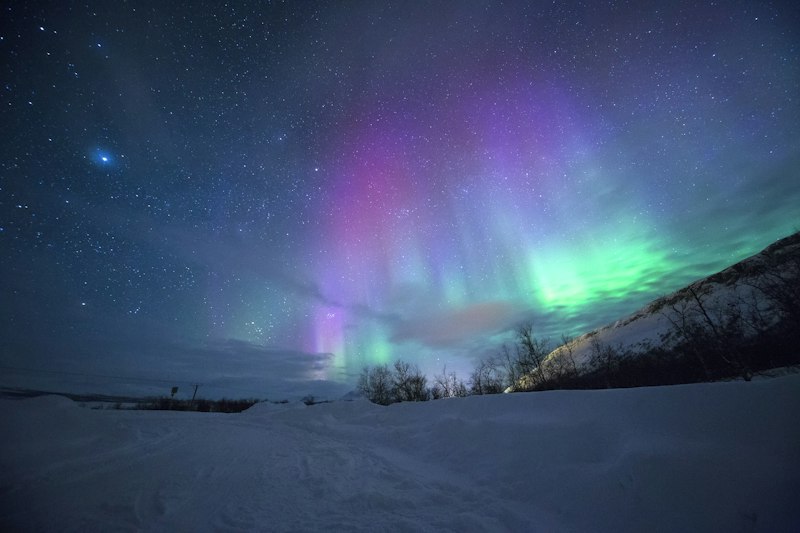
The sky turns first. A pale green shimmer bleeds up from the horizon, barely distinguishable from the stars until it pulses and twists into curtains of emerald and violet above a frozen lava field in absolute silence. This is Iceland at its most primordial: a country built by volcanoes and shaped by glaciers. Nowhere else delivers quite this combination of raw wilderness, geologic spectacle, Viking history, and skies that, from September to March, can catch fire with the aurora borealis.
Sitting beneath the auroral oval, the band where solar particles most often light up the atmosphere, Iceland offers some of the planet’s most reliable northern lights viewing. The Iceland northern lights season runs September through March, when nights are long enough for dark skies. The best time to see northern lights in Iceland is on a clear night near the new moon, away from city lights, when the aurora forecast shows moderate or higher activity. Northern lights tours in Iceland depart nightly from Reykjavik in season. Solar Cycle 25 peaked around 2024 to 2025, and although activity is now slowly declining, strong displays remain common for the next few years. And the aurora is only the headline act: Strokkur erupts every few minutes, Gullfoss thunders into its canyon, and black sand beaches are guarded by basalt columns. For independent travellers willing to rent a car and embrace unpredictable weather, Iceland rewards curiosity at every turn.
Chase the Aurora at Þingvellir, Vík, and the Snæfellsnes Peninsula Reykjavik’s light pollution is the enemy of aurora hunting. Drive about 45 minutes to Þingvellir National Park, a UNESCO site where the North American and Eurasian plates pull apart, for dark skies and the aurora reflected in Þingvallavatn lake. Before heading out, check the Icelandic Met Office’s aurora and cloud-cover forecast at vedur.is (activity is rated 0 to 9) or an app like My Aurora Forecast. Clear skies matter as much as activity. Along the south coast, Vík lets you photograph the lights over the Reynisdrangar sea stacks. For fewer crowds, head about two hours northwest to the Snæfellsnes Peninsula, where Snæfellsjökull glacier glows under the aurora.
Drive the Golden Circle Yourself Skip the tour bus. Rent a car and cover the Golden Circle (Þingvellir, the Geysir geothermal area, and Gullfoss waterfall) in a single unhurried day. At Geysir, watch Strokkur blast boiling water 15 to 20 metres into the air every five to ten minutes. The loop is roughly 230 to 300 kilometres on good roads. Leave Reykjavik by 8am to beat the coaches.
Soak in the Blue Lagoon or Sky Lagoon The Blue Lagoon’s milky turquoise water averages 37 to 39°C and is surrounded by lava fields. Book online well ahead, as time slots sell out. Entry starts at around ISK 12,000 (roughly $95) and includes a silica mud mask. The lagoon sits on the Reykjanes Peninsula near Grindavík, where repeated eruptions since late 2023 have caused temporary closures, so check safetravel.is and the lagoon’s website before you go. Closer to Reykjavik, Sky Lagoon offers an oceanfront infinity pool. Go at dusk in winter and you may catch the aurora while submerged in warm water.
Self-Drive the Ring Road Iceland’s Route 1 circles the island for about 1,322 kilometres, and seven to ten days gives you a proper taste. You will pass Skaftafell, Jökulsárlón lagoon (where icebergs break off Breiðamerkurjökull and wash up on Diamond Beach), the lava fields around Mývatn, and Akureyri in the north. In winter, rent a 4WD and check road.is and safetravel.is daily, as storms can close sections. The highland F-roads are closed in winter (typically opening from late June), are legally restricted to 4x4 vehicles, and river crossings are not covered by most rental insurance.
Budget: KEX in Reykjavik, a hostel and hotel in a converted biscuit factory, has shared and private rooms, a lively bar, and a great downtown location.
Mid-Range: Buubble, Iceland’s original bubble hotel, puts you in a heated transparent dome in a private forest clearing in South Iceland. Bubbles start from around €229 per night.
Luxury: Hotel Rangá in South Iceland sits far from city lights in prime aurora territory, with outdoor hot tubs, an on-site observatory, and a famous aurora wake-up call. Rooms start from roughly €430 per night.
For the northern lights, travel between September and March: the darker the nights, the better your chances. November through February brings the longest nights, with as little as four to five hours of daylight around the winter solstice, but also the roughest weather. September and March offer a good balance of dark skies and milder conditions, and the equinox months are often lively for aurora activity. Summer (June to August) trades the aurora for the midnight sun, when you can hike at midnight, but it is also peak season.
Keflavík International Airport (KEF) sits about 50 kilometres southwest of Reykjavik and has direct flights from the US East Coast (including Boston and New York) and most major European hubs, with Icelandair and other carriers. Flights from New York take around six hours. Outside the capital, a rental car is all but essential. Book early for winter, when demand for 4WDs spikes.
🎒 Pack for Iceland: Thermal Base Layers · Waterproof Winter Boots · Packable Down Jacket · Waterproof Gloves · Aurora Camera Tripod
🗺️ Book tours & experiences in Iceland: Browse on GetYourGuide → · Browse on Viator → 🌋 Golden Circle full-day tour: Book on Klook → 🌌 Northern lights hunting tour: Book on Klook → 🧊 Iceland glacier hike: Book on Klook →
🛡️ Travel insurance for this trip: Get covered with SafetyWing → 🔒 Stay secure while travelling: Get NordVPN →
Iceland does not require a guide, an expensive package, or a tour group. It requires a rental car, a good weather app, and the willingness to pull over when the sky goes green. Chase your own aurora, and stand in a lava field at midnight with nothing above you but light.