This bangkok travel guide covers the best things to do in bangkok, where to eat, where to stay, and how to reach the yi peng lantern festival in chiang mai. Bangkok is Southeast Asia at full volume: ancient temples, legendary street food, riverboats, night markets, and rooftop bars.
The tuk-tuk drops you at Wat Pho just after the gates open, when the temple is quiet and the morning light falls through the side doors in long slanted bars. The gold of the reclining Buddha fills its hall from wall to wall: 46 metres long, its feet inlaid with mother-of-pearl depicting the 108 auspicious characteristics of the Buddha. Outside, monks in saffron robes cross the courtyard and a boat horn carries from the river. Few cities on earth can make you feel this way before breakfast.
Bangkok is also a megacity at full tilt: more than 10 million people, traffic that defies logic, humidity that hits you at the airport door, markets that run through the night, and a food culture so good that travellers plan entire trips around it. It is chaotic, magnificent, and worth every sweaty moment.
Bangkok regularly ranks among the world’s most-visited cities, and the reasons hold up: extraordinary temples, world-class street food (a two-dollar pad see ew from a wok on wheels can beat most restaurants anywhere), and a river that still works as a transport artery. And Bangkok is a gateway: a flight of just over an hour reaches Chiang Mai and the Yi Peng Lantern Festival, one of the most beautiful events on earth.
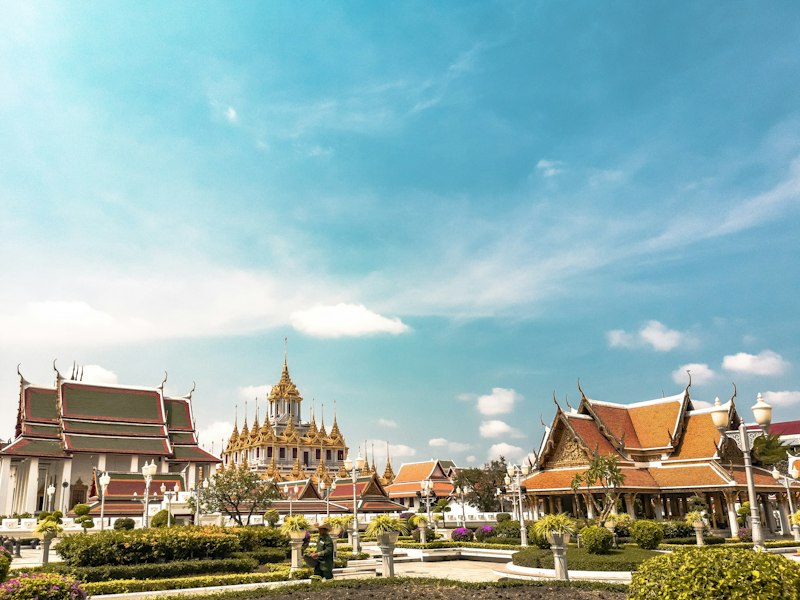
These sit side by side in the Rattanakosin Old City and fill a morning. Start at Wat Pho (300 baht, open from 8am), where the reclining Buddha is the priority: the scale stuns in person. Wat Pho is also the home of Thailand’s best-known traditional massage school, and a 30-minute Thai massage at the on-site pavilions costs roughly 340 baht (about $10).
Walk a few minutes north to the Grand Palace complex, which contains Wat Phra Kaew. The Emerald Buddha is smaller than you expect (66 centimetres) and more revered than anything else in the kingdom: it sits high on a gilded altar, and its robes are changed by the King three times a year, with the seasons. The surrounding chedis, pavilions, and throne halls dazzle with goldwork and mosaic tile. Admission is 500 baht (about $15) and includes Wat Phra Kaew and the Queen Sirikit Museum of Textiles; the palace is open daily from 8:30am, with last entry at 3:30pm. The dress code is strict: no bare shoulders, no knees, nothing sleeveless. Cover-ups are available near the entrance.
A short cross-river ferry from Tha Tien pier (a few baht) takes you to Wat Arun, Bangkok’s most distinctive silhouette: a towering Khmer-style prang encrusted with fragments of Chinese porcelain that catch the light from every angle. The steep stairs to the upper terraces are vertigo-inducing. Entry costs 200 baht, and the temple is open 8am to 6pm, so arrive at opening to beat the heat and the tour groups. For sunset, watch it glow from a riverside terrace on the opposite bank near Tha Tien.
One of the world’s largest weekend markets, with more than 15,000 stalls, runs Saturday and Sunday from about 9am to 6pm. Vintage clothing, ceramics, antiques, orchids, amulets, art, and street food: it is overwhelming and wonderful. Go before 11am, before the heat builds, and bring water and cash. Try the coconut ice cream and a fresh som tam while you browse.
Bangkok was historically a city of canals (klongs), and the Chao Phraya still runs through it as a working waterway. The Chao Phraya Express Boat links the temple district with Silom and the riverside hotels; the local orange-flag line costs under 20 baht, and the blue-flag tourist boat costs a little more.
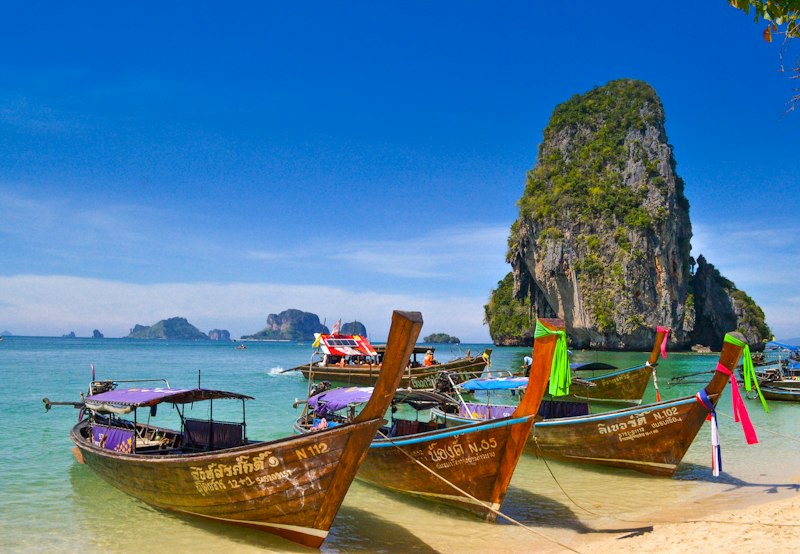
On the west bank, the canals of Thonburi can be explored by longtail boat: a private hour passes Wat Arun from the water and canal communities that have changed little in a century. Expect to pay roughly 1,500 baht per boat for an hour; agree the price and route before you set off.
Jim Thompson was an American businessman who revived Thai silk weaving after World War II and turned it into an international industry. His house on Khlong Saen Saep is a cluster of traditional teak houses moved from elsewhere and assembled here in the late 1950s, filled with Southeast Asian art and antiques. Thompson disappeared in Malaysia’s Cameron Highlands in 1967, a mystery never solved. Entry is 250 baht and includes a guided tour (the main house can only be visited with a guide).
Thailand’s most photographed floating market lies about 100 kilometres southwest of Bangkok and is busiest in the early morning. It is very touristy now, but boats piled with tropical fruit gliding between stilt houses are still a sight. Go as early as possible, ideally on a weekday, before the tour boats arrive. Most hotels sell day trips, or take a minivan from Bangkok’s Southern Bus Terminal.
Loy Krathong, celebrated nationwide on the full moon of the twelfth Thai lunar month, involves floating candlelit krathong baskets on rivers and lakes, and it is lovely on the Chao Phraya. But Thailand’s most extraordinary lantern event is Yi Peng in Chiang Mai, held at the same time.
At Yi Peng, thousands of paper sky lanterns (khom loi) rise into the night like a migration of small suns, and for ten or fifteen minutes the sky fills with drifting light.
In 2026, Loy Krathong and Yi Peng fall on 24 and 25 November, with celebrations in Chiang Mai running from about 23 November. Know the rules before you go: for aviation safety, lantern releases are banned in central Chiang Mai except in zones and time windows set by provincial authorities, and unauthorised releases carry criminal penalties. The famous mass releases take place at licensed, ticketed events outside the city, which sell out months ahead. In town, floating a krathong on the Ping River is free. Flights to Chiang Mai take just over an hour on Thai AirAsia, Bangkok Airways, Thai Airways, and other carriers, but schedules are often cut back on release nights, so confirm with your airline. Book accommodation early: Chiang Mai fills up for Yi Peng week.
Chiang Mai deserves several days regardless: the old walled city (founded in 1296), Doi Inthanon National Park, the Mae Hong Son Loop, and an excellent food scene.
Pad thai: Find a wok cart with high heat, a cook who has made one dish for decades, and a lunchtime queue. Jay Fai on Maha Chai Road is the famous version: a street-food cook who has held a Michelin star since 2018, with reservations needed well ahead. Thipsamai, on the same road, is the more accessible institution.
Som tam (green papaya salad): Pounded in a mortar with dried shrimp, lime, fish sauce, palm sugar, and chillies. Stalls are everywhere; Chinatown’s versions are excellent.
Khao man gai: Poached chicken on rice cooked in the chicken broth, with a punchy dipping sauce, cucumber, and clear soup. The definitive Thai comfort food.
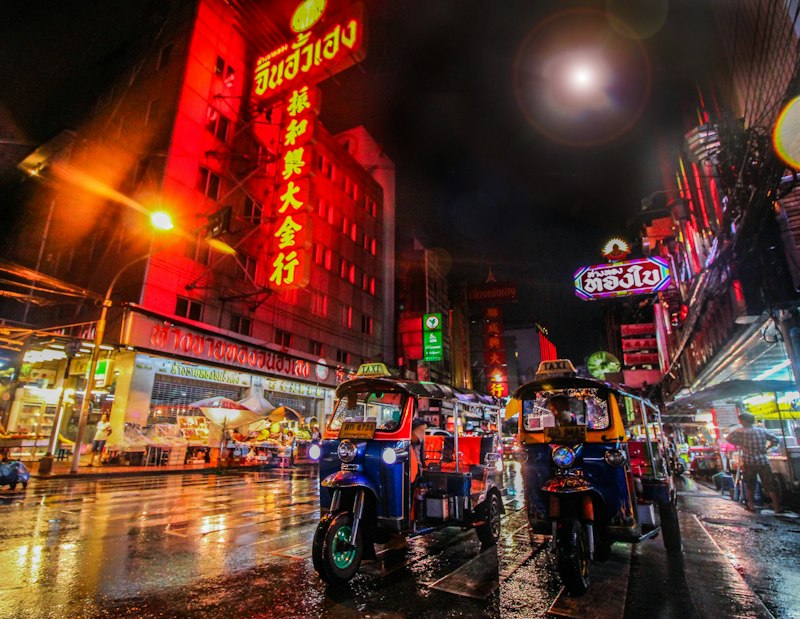
Chinatown (Yaowarat Road): A dense strip of gold shops, herb merchants, and some of the city’s best street food. Come after dark, when stalls fill the pavements with giant prawns, crab, and oysters cooked to order.
Rooftop dining: Sirocco at Lebua State Tower (where The Hangover Part II was filmed) and Vertigo at Banyan Tree are the classic sky-high splurges. Book dinner in advance.
Budget ($30 to $60/night): Lub d Bangkok Silom: A social hostel with dorms and private rooms that manages not to feel like a party hostel, in a central Silom location with easy BTS access.
Mid-range ($80 to $200/night): Riva Arun: A small boutique hotel on the Chao Phraya with Wat Arun views across the water.
Hotel Indigo Bangkok Wireless Road: Design-forward hotel in the embassy district with an excellent rooftop pool, a short walk from BTS Phloen Chit.
Splurge ($300+/night): Mandarin Oriental Bangkok: The legend. Opened in 1876 as The Oriental, Thailand’s first hotel, it has hosted Joseph Conrad, Somerset Maugham, and Noël Coward. Afternoon tea in the Authors’ Lounge is a Bangkok ritual. Rooms typically start above $400.
Park Hyatt Bangkok: Sleek luxury above the Central Embassy mall, with a rooftop bar and panoramic city views.
November to February is peak season: drier and a little cooler (roughly 26 to 32 degrees Celsius), ideal for walking and temples. November brings Loy Krathong and Yi Peng.
March and April are the hottest months, often topping 35 degrees. Songkran (Thai New Year) on April 13 to 15 turns the city into a giant water fight, that is either great fun or impossible, depending on your mood.
May to October is the rainy season: heavy downpours, lower prices, and fewer crowds. Rain usually falls in the afternoon and evening; mornings are often clear.
Suvarnabhumi Airport (BKK) is about 30 kilometres east of central Bangkok. The Airport Rail Link reaches Phaya Thai station, where it connects with the BTS, in about 30 minutes for 45 baht: the cheapest reliable option. A metered taxi from the official queue costs roughly 250 to 350 baht to Sukhumvit, plus expressway tolls and a 50-baht airport surcharge.
In the city, the BTS Skytrain and MRT subway cover the business and tourist districts. Both are clean, air-conditioned, and cheap (about 17 to 65 baht per trip, depending on distance). For the Old City temples, the river boat is fastest, and Grab covers everywhere the trains don’t reach.
🎒 Pack for Bangkok: Quick-Dry Lightweight Clothing · Compact Umbrella Travel · Anti-Theft Daypack · Travel Scarf Lightweight · Insect Repellent Deet
🗺️ Book Bangkok tours and experiences: Grand Palace and Wat Pho guided tours on GetYourGuide Bangkok street food night tours on GetYourGuide Chao Phraya river tours on Viator Bangkok day tours on Klook
🛡️ Travel insurance for Thailand: Get covered with SafetyWing → 🔒 Stay secure on public Wi-Fi: Get NordVPN →
Bangkok leaves you with contradictions: the serenity of Wat Pho at opening time and the frenzy of Chatuchak at noon, the ancient and the aggressively modern sharing the same air. It is not an easy city. It is an extraordinary one. And if you time it right, Chiang Mai is an hour’s flight north, the full moon is rising, and thousands of lanterns are about to lift into the sky.